
Monday, 30 November 2015
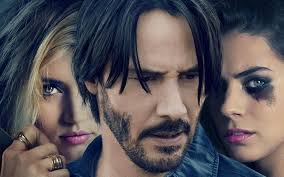
"Knock Knock"
Yesterday, I watched a horror film which inspired me due to some similarities to the film opening we are aiming to produce. The film is called "Knock Knock" and is a psychological horror which follows the story of a man named Evan, whose family leaves him for a weekend so that he can work. During his time at home he encounters 2 young girls who come to his house seeking shelter, however they are not as innocent as they seem. The girls coax Evan into having sex with them, before refusing to leave the house. They get inside his head and quickly send him crazy, because he doesn't want his family to come home to them. This is similar to our production because it is also taking place in a house with a lone person. It also is psychological, and shows how much a person can change in a short amount of time thanks to their psychological state of mind. I have taken many ideas from this and I look to share them with my group members Megan and Dan.

30/11/15 Update
Today, our group discussed ideas for actors & location shots which Megan will hopefully complete by December 1st - most convenient due to the chosen location being situated around our group members house. Additionally, we completed our progress report - presented through written formats & mind-maps to establish the plot for our production.
Our plot was initiated through our pilot survey results (allowing us to contrast the target audience preferences) & an existing students production work, which we chose to base our textual analysis on. - Dan Neary
.

.
Saturday, 28 November 2015
Friday, 27 November 2015
Focus Group
In horror films, what codes & conventions are most likely to impact the audience?
Editing that is of a faster pace
Reflections, dark low-key lighting
An Intriguing narrative
Subversions of stereotypes
Diegetic sound that influences
Discuss the expectations of the narrative in an opening to a horror film
Events based on real-life situations
Relatability of the plot to the audience
Counter opinion - subvert from cliché
Sudden jump-scares
Flash-backs for clear structure
Do horror films differ from the thriller genre?
Editing is of a slower pace
Similarities of colour representations
Low-key lighting
Horror introduces the set clearly
Would a female antagonist engage the audience less?
No, instead it encourages a different interpretation of the characters as oppose to the cliché of a male dominated lead role.
No, as it allows the stereotype to be subverted which would more than likely entice the audience as it is an aspect that is unusual for movies in the present day.
- Dan - Megan - Charlie
27/11/15 Update
In this lesson, I've uploaded my "Hypodermic Needle Model", which Megan and Dan will both also be using, I'm also going to borrow some work from Megan and Dan's blog, to complete my "audience profiles" section.
Wednesday, 25 November 2015
25/11/15 Update
This week, I will be looking to complete some parts of my theoretical research, including the audience theories, and narrative theory. I will also be e-mailing a professional, as I'm determined to expand the type of work I have done.
Tuesday, 24 November 2015
My Influential Figures

I have a few influential figures. One of which is the famous horror director, George Romero. He is known for creating the sub-genre in horror based around the undead. Romero directed Dawn of the Dead (1978). He also made a cameo appearance in Call of Duty Black Ops, as the creators of the game wanted him to represent the undead side-game. This would attract customers who admire his work.
George Romero's most famous film he directed, was Dawn of the Dead. A remake of this film was also made in 2004, sparking surprisingly high ratings from critics. The same year, a spin-off version was made named "Shaun of the Dead". This is my favourite film of all time, and without Romero, it wouldn't exist. I've always been a fan of the undead genre, therefore I have to look at Romero for inspiration. Many people couldn't imagine the horror genre without Romero's work, and several films, TV shows and games, are all indirectly inspired from his films.
 Another influential figure, this time an actor, is Andrew Lincoln. He plays the lead role in AMC's The Walking Dead, as Rick Grimes. Andrew Lincoln is a British actor famously known for his roles in many famous films and TV shows.
He inspires me because of his role in The Walking Dead, as it is my favourite TV show. I've watched 2 series with Andrew Lincoln in, the other was "Teachers". This isn't part of the horror genre, however because I saw him in that first, I felt a personal connection to him in The Walking Dead, therefore leading to him being so influential to me. Despite my man crush on Andrew Lincoln, he also gives a lot to the horror genre as a whole. He's a very convincing actor, who is also very versatile, having successfully played major roles in horror, comedy and romance productions. The Walking Dead is the most popular horror TV show in Britain and the USA. According to IMDb, the Walking Dead averages a score of 8.6/10 for each episode. Andrew Lincoln adds a lot to the horror genre as a whole. This is because he gives everything he has into his performances, making his character very believable. Additionally, he is a very likeable man in real life, therefore people warm to him, leaving him with millions of fans worldwide. This connects people to the show, and some that may have not preferred the horror genre before, will be coaxed into watching it now, due to their favourite actor being in it.
Thursday, 19 November 2015
Wednesday, 18 November 2015
Tuesday, 17 November 2015
Auteur Theory
Auteur Theory
Auteur theory is the theory of filmmaking in which 'the director is viewed as the major creative force in a motion picture' and it arised in France in the late 1940's. It states that the director, who oversees all audio and visual elements such as camera placement, blocking, lighting and scene lengths, is more to be considered the ''author'' of the movie than is the writer of the screenplay. These fundamental visual elements convey the message rather than the plot line. An auteur is someone whose style and practise is particularly distinctive such as Alfred Hitchcock.
Alfred Hitchcock is one of my influential figures and he is widely considered to be an auteur. He has reached auteur status by being the 'Master of mystery and suspense' as he likes to play with the audience's nerves through his directorial style. His style involves the visual expression of thought and psychology. Hitchcock's signature technical style involves the use of camera viewpoints , elaborate editing , a soundtrack to build suspense and he focuses on the creation of set pieces where he is able to demonstrate his talent for detail and suspense. He was known to collaborate with the same people when making his films and this allows him to create a consistency with his filmography.
 This mind map summarises the ways in which applying the Auteur theory to our own production would be effective. This is something we would have to consider carefully when deciding on final ideas for our production as it is important to create a distinctive style that will keep the audience engaged and wanting more. - Megan West
Alfred Hitchcock is one of my influential figures and he is widely considered to be an auteur. He has reached auteur status by being the 'Master of mystery and suspense' as he likes to play with the audience's nerves through his directorial style. His style involves the visual expression of thought and psychology. Hitchcock's signature technical style involves the use of camera viewpoints , elaborate editing , a soundtrack to build suspense and he focuses on the creation of set pieces where he is able to demonstrate his talent for detail and suspense. He was known to collaborate with the same people when making his films and this allows him to create a consistency with his filmography.

Wednesday, 11 November 2015
Textual Analysis of Student's Work
Captive
Captive is an AS Media production made by Kieran Panchal, Josh Manley, and Isaac Randall. It focuses on a young man, strapped to a chair in an abandoned broken building, who sees a demonic child holding a toy doll. The production is two minutes long, and has many good effects, and just a few negatives. One positive that is present throughout is the quality of the camera. It produces an HD quality films which creates a brilliant effect for the whole of the film. At the start, when blood is dripping down the boy's face, it's made to look very realistic due to the camera being able to focus on several different details. The make-up and camera combined make a more powerful intro to the production. This is because of how well done the make-up is. The blood dripping out of his mouth looks stiff, as if it's been in his mouth for a long time. The boy's face looks battered and bruised too, which suggests that he has been in a fight. We only see flashbacks of all that happened before he got to the chair. It appears that he was acting as a photographer or journalist, and got captured whilst on the job, he was then held Captive, hence the title of the movie. The title of the movie pulls you in, as with one word, it's more powerful, and really gives you an insight to what it is about. It's relevant to the content of the film too.
There is limited dialogue in this production. The only words said are "HELP", which shows the desperation inside of him. These words are screamed, making the whole scene more intense, as it happens towards the climax of the film. The rest of the production is rather quiet, with tension building music planted into it, which has a very good effect on the production, as it makes it clear it's a horror film. There are a variety of different shots used in this production, ranging from extreme close ups to long shots. Most of them are close ups due to the fact that the whole thing takes place in one small area, bar the flashbacks. The flashbacks themselves may have been implemented so that the producers of the film could shoot more scenes from different angles. Without them, the film would be very empty, with very few memorable moments. The guy acting didn't have to do much that required a lot of skill, however what he does act is done well, and is believable throughout. The use of CCTV looking cameras is exceptional, as it suggests that him being there is all set up, and the antagonist planned for somebody to end up there. We also don't see any weapons around, therefore we can only be left to guess what will happen to him.
Despite all of these positives there are some negatives of this production. Whilst the shots are good, as is the camera quality and make-up, the actual content leaves a lot to be desired. The shot looking out of the window is good, when you see the possessed child. However, besides that nothing much really happens.
Captive is an AS Media production made by Kieran Panchal, Josh Manley, and Isaac Randall. It focuses on a young man, strapped to a chair in an abandoned broken building, who sees a demonic child holding a toy doll. The production is two minutes long, and has many good effects, and just a few negatives. One positive that is present throughout is the quality of the camera. It produces an HD quality films which creates a brilliant effect for the whole of the film. At the start, when blood is dripping down the boy's face, it's made to look very realistic due to the camera being able to focus on several different details. The make-up and camera combined make a more powerful intro to the production. This is because of how well done the make-up is. The blood dripping out of his mouth looks stiff, as if it's been in his mouth for a long time. The boy's face looks battered and bruised too, which suggests that he has been in a fight. We only see flashbacks of all that happened before he got to the chair. It appears that he was acting as a photographer or journalist, and got captured whilst on the job, he was then held Captive, hence the title of the movie. The title of the movie pulls you in, as with one word, it's more powerful, and really gives you an insight to what it is about. It's relevant to the content of the film too.
There is limited dialogue in this production. The only words said are "HELP", which shows the desperation inside of him. These words are screamed, making the whole scene more intense, as it happens towards the climax of the film. The rest of the production is rather quiet, with tension building music planted into it, which has a very good effect on the production, as it makes it clear it's a horror film. There are a variety of different shots used in this production, ranging from extreme close ups to long shots. Most of them are close ups due to the fact that the whole thing takes place in one small area, bar the flashbacks. The flashbacks themselves may have been implemented so that the producers of the film could shoot more scenes from different angles. Without them, the film would be very empty, with very few memorable moments. The guy acting didn't have to do much that required a lot of skill, however what he does act is done well, and is believable throughout. The use of CCTV looking cameras is exceptional, as it suggests that him being there is all set up, and the antagonist planned for somebody to end up there. We also don't see any weapons around, therefore we can only be left to guess what will happen to him.
Despite all of these positives there are some negatives of this production. Whilst the shots are good, as is the camera quality and make-up, the actual content leaves a lot to be desired. The shot looking out of the window is good, when you see the possessed child. However, besides that nothing much really happens.
Subscribe to:
Posts (Atom)